
Why Do Stamping Presses Still Rely on Mechanical Pneumatic Counters?
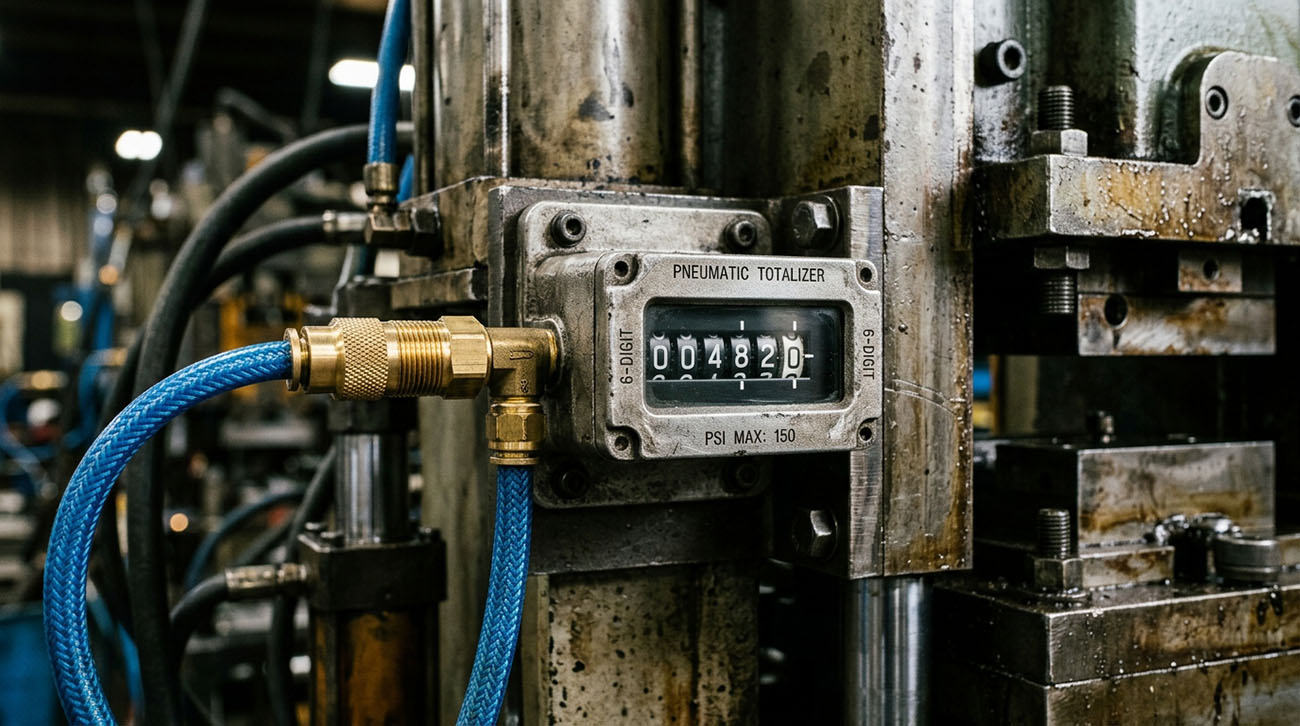
Extreme-Environment Production Tallying and Fluidic Pulse Metrology
Can severe mechanical shockwaves from heavy industrial forging presses and high-voltage electrical noise permanently scramble electronic digital production tally displays? When manufacturing conditions prohibit sensitive electronics or continuous electrical power, deploying heavy-duty pneumatic counters provides intrinsically safe mechanical pulse registration, permanent non-volatile figure retention, and total immunity to electromagnetic interference across extreme operating zones. In automotive metal stamping plants, explosive ammunition loading lines, and harsh chemical packaging facilities, accurate tallying of production cycles is vital for inventory control and automated machine cutoff. Analyzing fluidic escapement kinematics, integrating automated preset batch valves, and evaluating mechanical shock absorption ensures industrial production lines maintain unbroken count integrity without digital fragility.
Plant managers and tool engineering teams frequently struggle with digital tallying failures on aggressive production equipment. Electronic pulse counters on high-speed punch presses or vibratory bowl feeders endure constant mechanical abuse. Surface-mount printed circuit board components crack, soldered ribbon cables fracture, and digital LCD screens bleed liquid crystal fluid under repetitive acceleration loads. Transitioning to rugged fluidic tallying instruments resolves the conflict between high-speed production tracking and extreme mechanical shock endurance.
Mechanical Fundamentals and Fluidic Escapement Actuator Dynamics
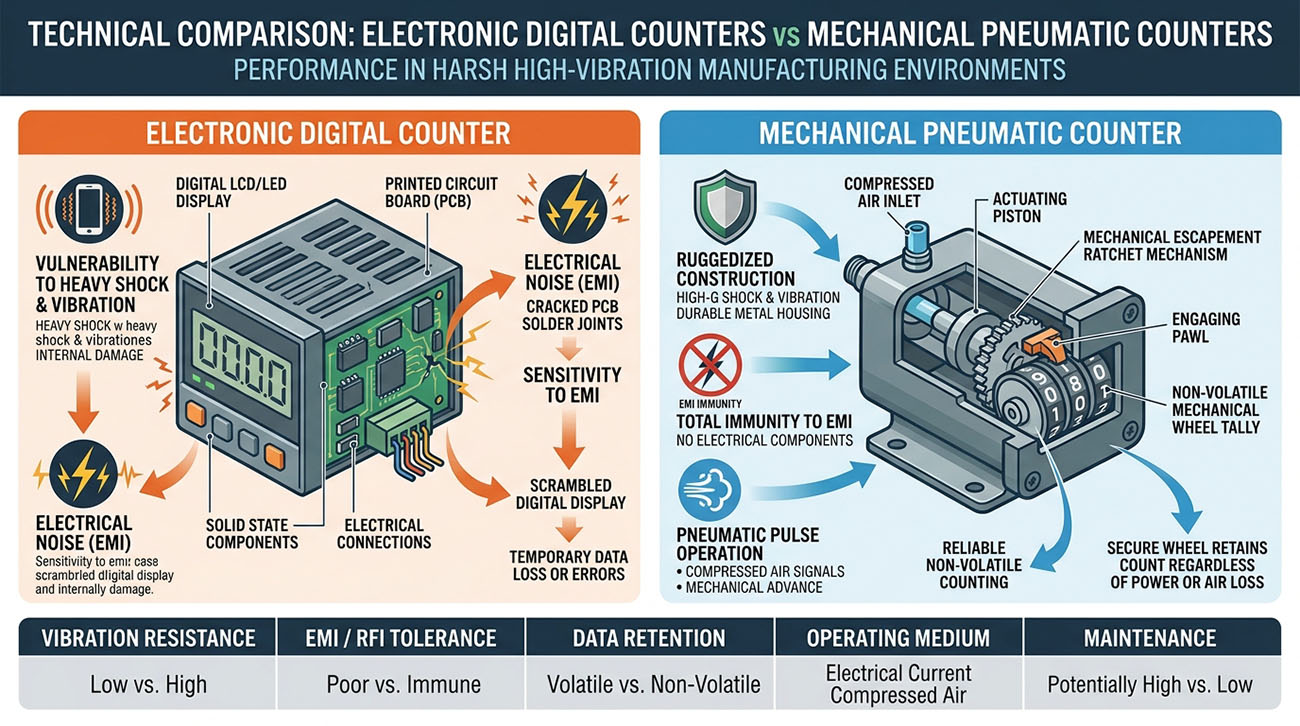
The physical operation of an industrial pneumatic impulse counter is rooted in precision fluidic escapement mechanics. Unlike electronic tally units that require continuous electrical excitation and microcontrollers to increment digital memory registers, a pneumatic counter remains completely inert until an incoming pressure pulse arrives. When a machine-actuated pneumatic limit switch or proximity sensor trips, a brief pulse of compressed air enters the counter inlet port.
Inside the counter housing, the incoming air pressure acts against a miniature elastomeric bellows or spring-loaded piston actuator. The piston's mechanical displacement advances a precision ratchet escapement wheel by exactly one tooth, rotating the primary unit's figure wheel by one digit. Each decade wheel features deep-engraved, high-contrast numerals driven by precision transfer pinions that advance higher decade orders smoothly as the count accumulates.
Once the pressure pulse vents through the machine valve, a tempered stainless steel return spring resets the actuator pawl, priming the mechanism for the subsequent count stroke. This mechanical sequence operates reliably at cycling frequencies up to 25 pulses per second (1,500 counts per minute). Because the count register is physically locked by mechanical gearing, the display provides permanent non-volatile memory that cannot be erased by plant power outages, lightning surges, or electrical noise.
Why Digital Electronic Counters Fail on High-Vibration Heavy Machinery
Machinery builders often assume modern digital electronic counters are superior simply because they use digital microprocessors and LED displays. Specifying electronic tally modules on high-impact metalforming equipment or inside hazardous chemical production lines represents a severe engineering miscalculation.
Electronic counters suffer three fundamental physical failure modes under aggressive industrial conditions:
- Solder Joint Fatigue and Surface-Mount Component Shedding: Continuous 20g to 50g shockwaves from mechanical forging presses and stamping dies cause solder-joint micro-cracking; surface-mount capacitors and microprocessors detach from circuit boards, causing total instrument failure.
- Electromagnetic Noise and False Digital Pulse Induction: High-frequency electrical transients from automated resistance welders, plasma cutters, and variable frequency drives (VFDs) induce false voltage spikes in sensor wiring, corrupting production tallies with phantom counts.
- LCD Display Shattering and Liquid Crystal Bleeding: Thin glass liquid crystal displays crack under severe mechanical vibrations; internal fluid leakage permanently blacks out the digital display, blinding machine operators to critical production metrics.
Attempting to protect fragile electronic counters with external rubber isolation dampeners increases cabinet complexity without eliminating electrical noise corruption. In contrast, pneumatic counters utilize heavy-gauge cast zinc bodies, solid metal pinions, and Delrin gear wheels that absorb violent mechanical shock without skipping counts. By installing rugged pneumatic counters, production engineers eliminate tallying errors and frequent instrument replacements.
Automated Preset Batch Control via Integrated Fluidic Power Valves
In high-volume manufacturing facilities, tallying parts represents only the first stage of automation; production equipment must also take immediate physical action once a batch quantity is reached. Pneumatic preset batch counters combine high-accuracy mechanical counting with an integrated high-flow pneumatic power valve. Operators dial in the desired production quantity using front-panel pushbuttons, setting the mechanical decade wheels to the target batch number.
During machine operation, each incoming air pulse decrements the internal register, providing operators with a clear visual display of remaining cycles. At the exact millisecond the register reaches zero, an internal mechanical trigger shifts a balanced pneumatic spool valve, delivering a 90 psi pneumatic output signal. This high-pressure air pulse directly activates diverter gates, clamps material shears, triggers acoustic warning horns, or shifts primary directional control valves to stop machine drive motors instantly.
Operators can reset the preset counter for the next batch run manually via a front-panel reset button or automatically via an external pneumatic reset signal. By routing an air pulse from a downstream transfer conveyor back to the counter reset port, engineers create a fully autonomous, closed-loop batching cell. This fluidic batching automation operates with flawless repeatability inside explosive paint mixing rooms, chemical packaging lines, and dusty grain elevators without requiring electronic programmable logic controllers.
Comparative Performance Matrix for Industrial Production Counters
|
Counter Technology |
Shock & Vibration Rating |
Class I Div 1 Explosion Safety |
Data Retention During Power Loss |
Electromagnetic Noise Resistance |
|
Heavy-Duty Pneumatic Impulse Counter |
Exceptional (>30g continuous mechanical shock) |
Inherently 100% spark-free; zero barrier needed |
Permanent mechanical geared memory |
Total immunity; zero electrical wiring |
|
Pneumatic Preset Batch Controller |
Exceptional (>25g continuous acceleration shock) |
Inherently 100% spark-free; integrated valve |
Permanent mechanical geared memory |
Total immunity; pure fluidic signaling |
|
Standard Digital Panel Counter |
Poor (<5g; solder cracking & LCD failure) |
Requires costly explosion-proof NEMA 7 box |
Requires battery backup; data lost on failure |
Vulnerable to false counts from VFD/welder noise |
|
Electromechanical Solenoid Counter |
Moderate (10g; internal coil spring fatigue) |
Carries spark ignition risk on coil release |
Mechanical non-volatile figure wheels |
Moderate; inductive spikes can glitch sensors |
|
Optical Laser Part Counter |
Very Poor (Optical lenses misalign under shock) |
Unsafe in volatile dusty/explosive atmospheres |
Requires digital PLC memory retention |
High; lens contamination causes missed tallies |
Diagnostic Quality Calibration Protocol for Pneumatic Pulse Counting Systems
Ensuring precise, uninterrupted tally registration on high-speed production machinery requires systematic calibration of pneumatic signal lines. Because pneumatic counters depend on clean fluidic pressure pulses, verifying pulse duration, pressure amplitude, and exhaust venting is vital.
A robust diagnostic inspection protocol incorporates three standardized evaluation methodologies:
- Dynamic Pulse Pressure and Rise-Time Oscillography: Fast-response piezoelectric pressure transducers record the incoming air pulse profile, verifying that pressure reaches at least 30 psi within 10 milliseconds to ensure crisp escapement indexing.
- High-Speed Escapement Frequency Limit Testing: Variable-frequency fluidic signal pulsers cycle the counter at incrementally increasing pulse rates up to 30 Hz, confirming that the escapement wheel indexes accurately without pulse clipping.
- Return Spring Tension and Reset Valve Stroke Verification: Mechanical force gauges measure actuator return-spring force, confirming the pawl resets completely within 15 milliseconds after pressure drops below 5 psi.
Systematic diagnostic calibration ensures pneumatic tally systems record every production stroke without missing pulses. Documenting calibration data satisfies strict ISO 9001 quality audit standards across defense, automotive, and medical manufacturing. Rigorously calibrated pneumatic counters deliver decades of trouble-free production tracking in the most punishing manufacturing environments.
Precision Industrial Tally Automation with Ellis Kuhnke Controls
Overcoming the destructive shock, vibration, and explosion risks of modern manufacturing requires abandoning fragile digital electronic tally displays in favor of heavy-duty pneumatic counters. By using mechanical escapement actuators driven by compressed-air pulses, industrial plants achieve indestructible counting precision, permanent mechanical memory, and zero-spark safety. Integrating automated preset batch valves lets facilities automate production cutoff sequences safely without complex electronics.
Related Reading
- Pneumatic Timers: What Should You Confirm Before Replacing a Timing Unit?
- Pneumatic Controls: What Should You Check When a Valve, Timer, and Pressure Signal Do Not Agree?
- Understanding Pneumatic Timer Failures in Real-world Applications
- How Do You Troubleshoot Pneumatic Controls When a Machine Cycles Out of Sequence?
- What Are Pneumatic Controls, and How Do You Choose or Use Them Correctly?


- Ellis/Kuhnke Controls
132 Lewis Street Unit A-2, Eatontown, N.J. 07724
Phone: 1-800-221-0714
Fax: 732-291-8154
Email: Info@ekci.com
- Home Pneumatic Controls Technical Info CAD Drawings Contact Us Pneumatic Timers Blog Site Map