
What Are Pneumatic Controls, and How Do You Choose or Use Them Correctly?

A pneumatic control problem often shows up as the wrong machine action rather than an obvious broken part. A cylinder hesitates, a valve fails to shift, a timer fires late, or a counter misses a cycle while the visible component still looks normal. The part at the panel or manifold may not be the real failure point. The air signal behind it may be weak, leaking, blocked, delayed, contaminated, or routed through the wrong device.
Pneumatic controls use compressed air to start, stop, delay, count, indicate, regulate, or move part of a machine or system. Choosing one correctly starts with the job the control must perform, then moves to pressure range, porting, mounting, signal type, and the final machine result. A good replacement does more than fit the old space. It restores the correct action without introducing any new pressure, timing, flow, or compatibility issues.
Pneumatic Controls in Plain Terms
A pneumatic control uses compressed air to generate a useful machine command or response. In one circuit, that response might be a delayed signal. In another, it might be a valve shift, a cylinder stroke, a pressure indication, a counted cycle, or a regulated supply condition. The control only makes sense when you know what action it supports.
That is why we start with function before part appearance. Two parts may look similar from the outside and behave differently inside the circuit. A buyer who matches only the body shape, thread, or panel opening may receive a part that installs cleanly but still causes poor timing, weak motion, signal loss, leakage, or an unreadable status condition.
| Control family | What it controls | What to confirm before ordering |
| Pneumatic timer | Delays, sequences, or repeats an air signal. | Timing range, reset behavior, porting, mounting, signal logic. |
| Pneumatic valve | Starts, stops, redirects, exhausts, or regulates airflow. | Ways and positions, actuation method, port size, flow capacity, pressure range. |
| Pneumatic indicator | Shows a pressure, flow, signal, or position condition. | Condition shown, pressure range, port type, visibility, environment. |
| Pneumatic counter | Tracks cycles, strokes, parts, or machine events. | Actuation pressure, digit count, reset method, panel fit, readout style. |
| Cylinder or actuator | Converts air pressure into movement. | Bore, stroke, force, mounting, rod style, speed control, normal position. |
| Regulator, switch, fitting, or solenoid | Supports pressure control, sensing, connection, or electrical-to-air control. | Rating, thread, voltage, tubing size, environment, compatibility. |
Why the Control Job Comes Before the Part Number
The same component family solves different problems depending on where it sits in the circuit. A timer may control a sequence step, a valve may route the main air, an indicator may show only the presence of pressure, and a cylinder may need to overcome a specific load. The product family matters, but the control job matters first. The part number only helps after the circuit function is clear.
This matters most when the old label is missing, the equipment is down, or an equivalent part is needed. A replacement should restore the pressure, timing, flow, motion, count, or signal state the machine relies on. If the function is not defined, the order becomes a guess with a better-looking package. A clear control job gives us enough detail to narrow the product family and avoid a second failure after installation.
| If the machine needs... | Start with... | Do not assume... |
| A delayed or repeated air signal | A pneumatic timer with the correct timing range and reset style. | Any timer with similar ports will produce the same sequence. |
| Air routed to a different path | A valve matched to ways, positions, actuation, and flow. | A valve body that fits will shift the circuit correctly. |
| Visible pressure or signal status | An indicator matched to the condition being proved. | Pressure presence proves flow, motion, or full readiness. |
| A reliable cycle count | A counter matched to signal strength, reset style, and readout needs. | Any counter will catch the pulse length in the circuit. |
| Linear force or travel | A cylinder matched to bore, stroke, mounting, and load. | The same stroke length means the same usable force. |
How a Pneumatic Control Loop Works
A pneumatic loop starts at the air source and then passes through tubing, fittings, regulators, valves, timers, switches, indicators, counters, actuators, or cylinders. The path changes from supply air to control signal to physical result. When one point along that path fails, the symptom may appear elsewhere. A weak supply line may look like a bad valve, and a leaking branch line may look like a bad actuator.
The safest way to choose a replacement is to follow the signal path from source to result. Main air must be present and stable. The control device must receive the correct input and send the expected output. The downstream part must respond within the correct range, and the machine action must demonstrate the control result. Part movement alone is not enough if the process still fails.
The Signal Path to Check
- Main air is present, clean, dry, and stable enough for the circuit.
- Tubing and fittings are connected, open, and leak-free.
- The control device receives the correct input and produces the expected output.
- Branch or pilot pressure reaches the downstream component.
- The actuator, cylinder, valve, counter, or indicator responds in the required range.
- The machine result proves the control action, not only visible part movement.
| Loop point | What to verify | What a failure looks like | Ordering risk |
| Air supply | Pressure level, filtration, dryness, compressor stability. | Several devices drift, move slowly, or fail together. | Local parts get replaced while the shared source remains wrong. |
| Tubing and fittings | Leaks, kinks, blocked lines, wrong connections. | Signal arrives late, drops off, or fails to hold. | A new control repeats the same symptom. |
| Controller or timer | Input, output, timing range, reset behavior. | Sequence is early, late, missing, or inconsistent. | A timer match by size misses the timing function. |
| Valve or solenoid | Porting, actuation, coil voltage, flow direction. | Air fails to shift, exhaust, route, or hold. | The replacement has the wrong ways, positions, or voltage. |
| Cylinder or actuator | Stroke, bore, force, mounting, normal position. | Motion is weak, short, slow, or inconsistent. | The part fits but lacks force or geometry match. |
| Machine result | Actual motion, count, pressure, flow, or output. | The part responds, but the process still fails. | The real issue sits in the load, linkage, or equipment. |
How to Choose the Right Pneumatic Control
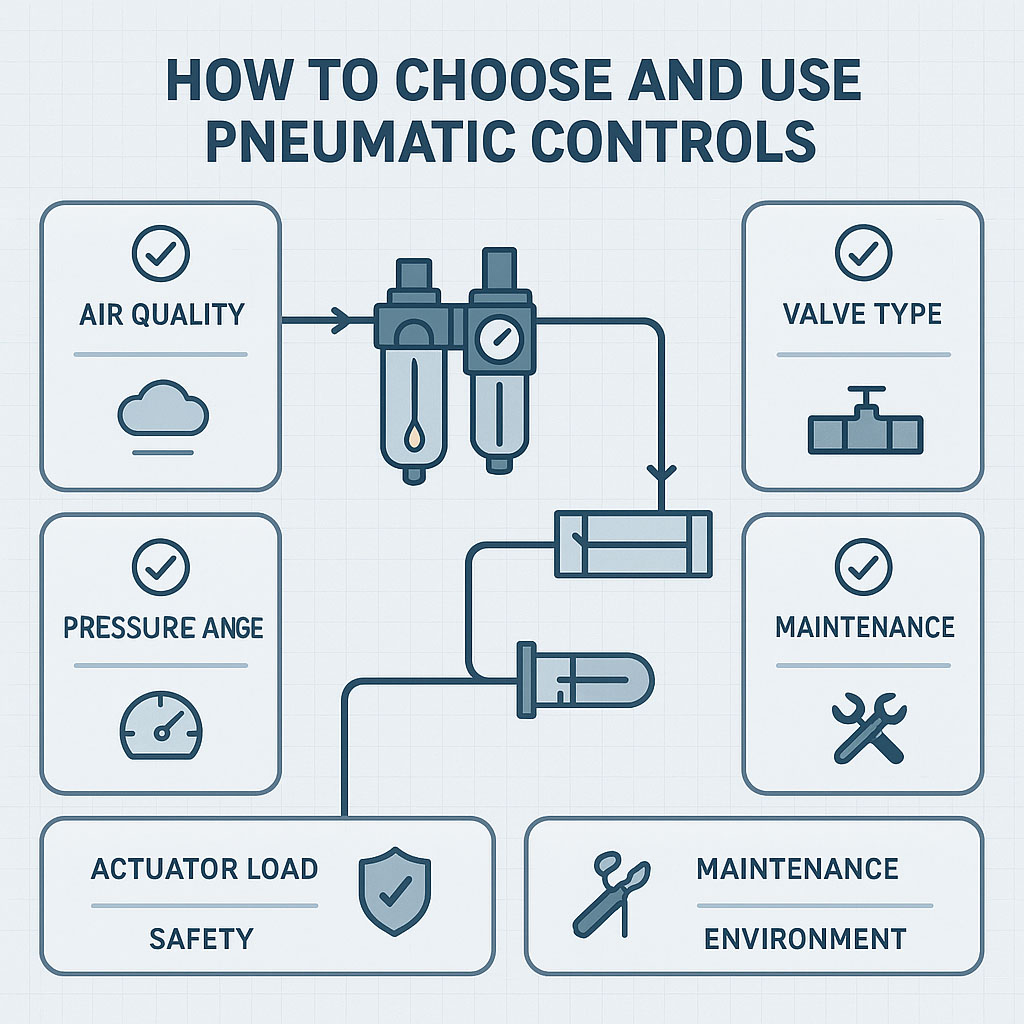
Choosing the right pneumatic control begins with the action the machine needs. The question is not only what failed. The better question is what should happen when the air signal changes. That answer points to the product family; the specifications then narrow down the exact replacement or equivalent.
Pressure range matters because a part that fits physically may still respond too early, too late, too weakly, or not at all. Port size, thread type, mounting, voltage, media, environment, and tubing condition matter for the same reason. The right part has to fit the circuit, the machine, and the operating condition. That is what separates a true replacement from a similar-looking component.
Match These Details Before You Order
- Function: delay, shift, indicate, count, regulate, move, sense, or connect.
- Pressure range: normal operating pressure and maximum pressure at the device.
- Porting and connections: port size, thread type, tube size, fitting style, sealing method.
- Actuation style: manual, mechanical, pilot, solenoid, spring return, maintained, or momentary.
- Electrical details: voltage, duty cycle, coil type, connector style, and environment for solenoid devices.
- Mechanical fit: panel cutout, manifold pattern, body depth, mounting holes, rod style, bore, and stroke.
- Operating environment: heat, oil mist, dust, washdown, vibration, outdoor exposure, or contamination.
| Component | Specification that usually decides the match | Why it matters |
| Timer | Timing range, repeatability, reset behavior, porting. | The sequence must occur at the right time and reset properly. |
| Valve | Ways, positions, flow capacity, actuation method, porting. | The valve must route or exhaust air exactly as the circuit requires. |
| Indicator | Condition shown, pressure or flow range, visibility, mounting. | The status must prove the right condition, not a vague pressure presence. |
| Counter | Pulse type, pressure range, reset method, digits, panel fit. | Short pulses or wrong reset behavior create missed counts. |
| Cylinder | Bore, stroke, force, rod, mounting, speed control. | A part that fits the length may still lack force or mounting geometry. |
| Solenoid | Voltage, coil duty, valve configuration, connector, environment. | Electrical match and air-path match both matter. |
Common Failure Patterns Before Replacement
Many pneumatic control failures begin upstream of the part that gets blamed. Low pressure, wet air, dirty air, leaking tubing, damaged seals, clogged fittings, incorrect pressure ranges, sticking spools, and mechanical binding can all cause misleading symptoms. A visible part may appear to be the problem because it is the last part in the chain to respond.
A short check before ordering saves time. It also prevents the most frustrating outcome: installing a new part only to see the same failure again. The goal is not to diagnose an entire machine on its own. The goal is to collect enough facts to determine whether the failure is due to the air source, the signal path, the component, or the machine action.
| Symptom | Likely checks | Replacement risk |
| Several devices act weak or slow. | Main pressure, compressor output, filter, regulator, moisture, common supply line. | Replacing one local device misses a shared air problem. |
| One station fails to sequence. | Timer output, pilot signal, valve shift, tubing leak, reset condition. | A new timer does not fix a valve, signal, or reset issue. |
| Valve does not shift. | Supply pressure, pilot pressure, solenoid voltage, coil condition, porting, contamination. | The wrong valve configuration creates another failure. |
| Cylinder moves but stops short. | Load, bore, stroke, pressure, restriction, alignment, mechanical binding. | The replacement matches the stroke but not the force or the mounting. |
| Indicator shows no pressure. | Actual pressure at the port, blocked fitting, range, location, indicator condition. | The indicator gets replaced even though no pressure reaches it. |
| Counter misses counts. | Actuation signal, pulse length, reset, pressure range, mechanical mounting. | The new counter misses the same signal condition. |
What to Have Ready When You Call or Request a Quote
The best request gives enough information to identify the correct product family and narrow the exact match. A photo helps when the label is worn, but a photo alone rarely tells the whole story. Two parts may share a similar face, body, or thread and still use different pressure ranges, reset behavior, flow paths, actuation styles, or mounting requirements.
Bring the details that connect the part to the machine action. Even partial information helps. If the old part number is readable, use it. If it is not readable, describe what the part controls, what should happen when it works, what pressure is present, and how the part mounts to the machine or panel.
| Part details | Application details |
| Old part number, brand, series, or clear photo of the label. | What the part controls and what should happen when it works. |
| Port size, thread type, tubing size, fitting style, and mounting style. | Pressure available at the device and expected operating range. |
| Timing range, voltage, actuation method, readout, reset, or normal position. | Machine type, cycle rate, environment, and urgency. |
| Bore, stroke, force, rod style, and mounting for cylinders or actuators. | Whether this is a one-piece replacement, production quantity, or recurring order. |
How to Make the Correct Choice
Pneumatic controls are compressed-air devices that create, direct, delay, count, indicate, regulate, or convert an air signal into a machine action. They include timers, valves, indicators, counters, cylinders, regulators, solenoids, switches, fittings, and related control components. They work correctly only when the part matches the function, pressure range, signal path, mounting, environment, and final machine result.
The correct choice starts with the control job, not the part appearance. Identify what the machine should do, trace the air and signal path, confirm the required specifications, then match the part to the application. That approach reduces wrong orders, repeated failures, and downtime after the replacement arrives.
Related Reading

- Ellis/Kuhnke Controls
132 Lewis Street Unit A-2, Eatontown, N.J. 07724
Phone: 1-800-221-0714
Fax: 732-291-8154
Email: Info@ekci.com
- Home Pneumatic Controls Technical Info CAD Drawings Contact Us Pneumatic Timers Blog Site Map