
How Do You Troubleshoot Pneumatic Controls When a Machine Cycles Out of Sequence?
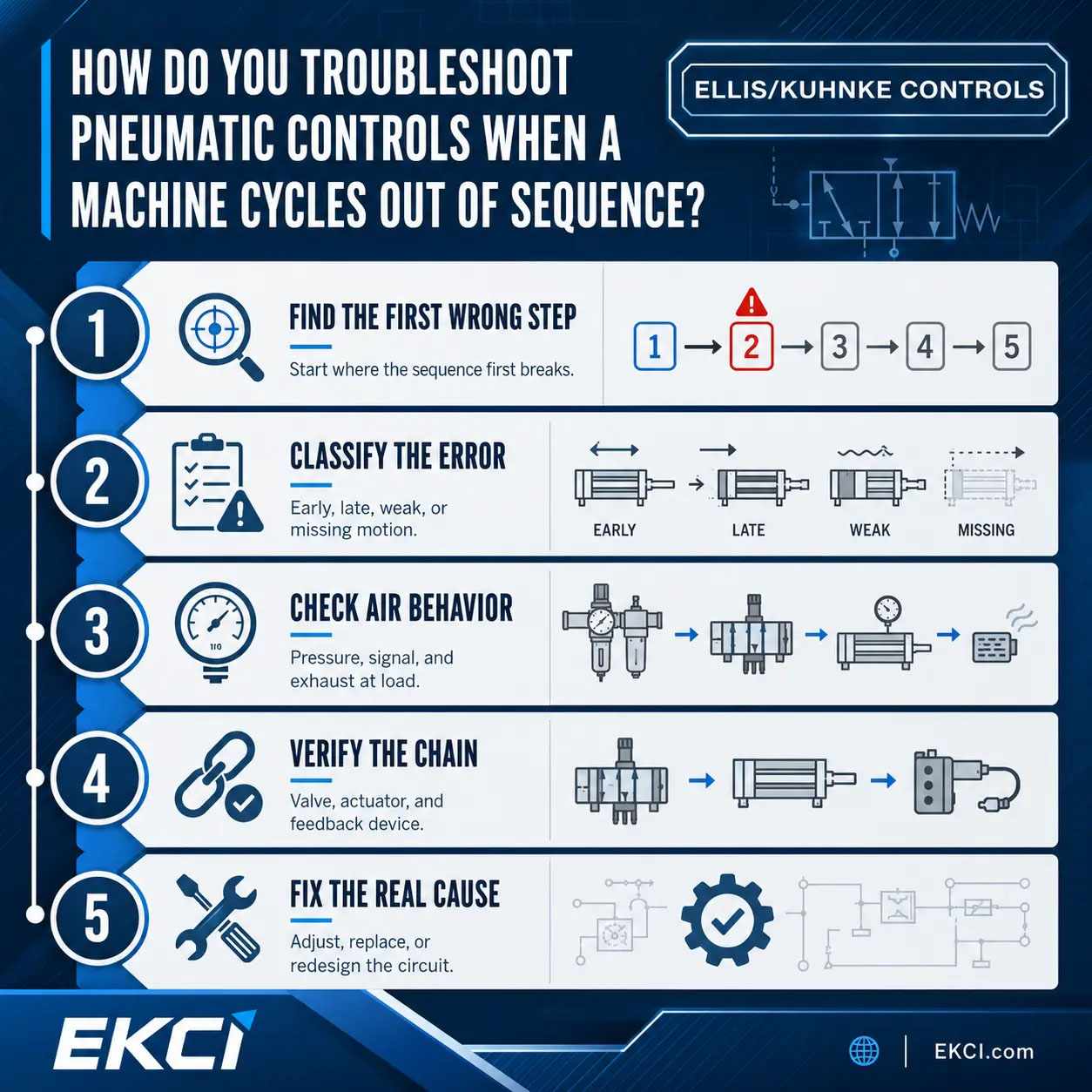
A machine that cycles out of sequence usually has one pneumatic event happening too early, too late, too weakly, or not at all. The fastest way to troubleshoot the problem is not to replace valves at random. It is to find the first wrong step in the sequence.
Once that first wrong step is identified, the fault path becomes much clearer. The issue may involve air supply, signal pressure, exhaust restriction, valve actuation, actuator movement, or feedback failure. The goal is to compare what the machine should do with what it actually does, and then isolate the first point at which the sequence breaks.
Start With the First Wrong Step
Out-of-sequence faults often appear larger than they are because a single bad event can make subsequent events appear wrong. A clamp may open early, an indexer may move before the part is seated, or a press may fire before the prior step finishes. Those later symptoms may trace back to one earlier pneumatic signal.
Start by documenting the intended sequence as physical machine events. Name each actuator, expected motion, signal, and observed fault. This gives you a clear diagnostic boundary instead of chasing the most visible symptom.
Before hands enter the machine area, control stored air energy, trapped pressure, and restart conditions according to your facility’s lockout/tagout procedure. Pneumatic systems can still move after the main air supply appears isolated if pressure remains trapped in lines, cylinders, or valves.
Identify the Type of Sequence Error
The kind of sequence error helps narrow the fault path before parts are removed. An early event may indicate an unintended signal, a leaking pilot path, a misadjusted feedback device, or a valve actuator responding before the logic is satisfied. A late event may indicate low signal pressure, sticky valve movement, restricted exhaust, slow actuator travel, or feedback that is received but not read at the right time.
| Sequence error | What it means | Likely fault path |
| Early event | Motion starts before the prior step finishes | Unintended signal, leaking pilot path, misadjusted feedback, premature valve actuation |
| Late event | The correct motion happens too slowly | Low pressure, restricted exhaust, sticky valve, slow actuator, delayed feedback |
| Skipped event | A required motion or valve shift does not happen | No signal, weak pilot pressure, failed valve shift, blocked actuator movement |
| Repeated event | Motion triggers more than once | Signal bounce, leakage, unstable feedback, poor reset |
| Partial event | The actuator moves but does not reach position | Low force, worn seals, external load, poor alignment, restricted flow |
Focus on the first wrong event, even if later symptoms look more dramatic. If a 5/2 pneumatic directional control valve sends a cylinder forward too late, the next station may index incorrectly and fault at a downstream sensor. Replacing the downstream device will not correct the original timing error.
Check Pressure, Signal Strength, and Exhaust at the Faulted Step
Once the first wrong step is identified, check whether the pneumatic control system has sufficient air energy and signal quality to execute it. A main line gauge may look normal while the pilot line feeding a valve drops below reliable shifting pressure during a fast cycle. The useful reading is the pressure at the faulted device while the machine is cycling.
A fault that looks electrical, mechanical, or logical can still come from air behavior. A slowly retracting cylinder may delay a feedback signal, causing the next pneumatic control step to arrive late. A weak pilot signal may cause a valve to shift halfway, chatter, or shift only after pressure recovers.
Check pressure drop under load, not only at rest. Inspect tubing, filters, regulators, mufflers, silencers, flow controls, and exhaust paths. Restricted exhaust can be as disruptive as weak supply pressure because air must leave the actuator before motion can complete.
Diagnose the Valve, Actuator, and Feedback Device
After pressure, exhaust, and signal quality are confirmed, follow the cause-and-effect chain. Check whether the valve receives the signal, whether the valve shifts, whether the actuator moves correctly, and whether the feedback device confirms the completed motion. Each failure mode can create the same out-of-sequence symptom.
Sticky directional valves often show up as hesitation, inconsistent timing, or movement only after a pressure spike. Contamination, dried lubricant, worn seals, weak return springs, and mechanical side loading can all affect how a pneumatic directional control valve shifts. Slow cylinders should be checked for external load issues and internal leakage, as a cylinder may move but still lack the force or speed needed to maintain sequence.
Feedback devices should be checked against actual position, not only against the controller or panel state. A sensor may show a signal, but the actuator may not be reaching the correct position with enough consistency. This matters when one delayed or misread end-of-stroke signal controls the next pneumatic event.
Decide Whether the Fix Is Adjustment, Replacement, or Circuit Redesign
Some sequence problems have simple causes. Restoring pressure, clearing an exhaust restriction, tightening a feedback bracket, correcting a flow-control setting, or replacing a worn seal may resolve the fault. A one-time fault with a clear cause usually points to adjustment or component repair.
Recurring sequence faults need a broader review. The circuit may have poor timing margin, an aging actuator, an undersized valve, a marginal signal, or a feedback device mounted too close to the edge of reliable travel. Turning a pneumatic flow control valve until the machine runs again may hide the problem without creating a durable repair.
Any replacement should match the existing circuit function, porting, actuation method, return style, flow capacity, and operating pressure requirements. This is especially important when replacing a 4/2 pneumatic directional control valve, a 5/2 pneumatic directional control valve, or a pneumatic control valve actuator used inside an interlocked sequence.
Partner With Ellis/Kuhnke Controls Before the Fault Repeats
Troubleshooting pneumatic controls starts with one question: where does the actual machine sequence first break from the intended sequence? Once that point is clear, the diagnosis should move through air supply, signal pressure, exhaust, valve actuation, actuator movement, and feedback confirmation. This method prevents unnecessary part replacement and keeps attention on the real cause of the sequence error.
If the fault keeps returning, the machine may have worn components, poor timing margin, or outdated pneumatic control logic. Ellis/Kuhnke Controls can help review the application, match replacement parts to the existing circuit, and support a more reliable repair path. Partner with Ellis/Kuhnke Controls before replacing another valve, adjusting another flow control, or accepting a recurring sequence fault as normal machine behavior.
Related Reading
- How to Choose a Pneumatic Indicator without Creating False Status
- How to Optimize Pneumatic Control Systems with the Right Timers
- Pneumatic Timers: How to Select the Right Model for Your Circuit
- Basic Principles of Pneumatic Control Systems
- PT vs. PMT vs. PMTV Pneumatic Timers: What Actually Changes in the Circuit


- Ellis/Kuhnke Controls
132 Lewis Street Unit A-2, Eatontown, N.J. 07724
Phone: 1-800-221-0714
Fax: 732-291-8154
Email: Info@ekci.com
- Home Pneumatic Controls Technical Info CAD Drawings Contact Us Pneumatic Timers Blog Site Map