
Why Pneumatic Timers with the Same Time Range May Work Differently
Two pneumatic timers can both include ten seconds on their dials and still be wrong for each other's circuits. One may delay an output after an input arrives; another may delay a change after that input is removed. Their output behavior, reset requirements, connections, and operating limits can differ as well. Matching the adjustable time range is only one part of selecting a replacement.
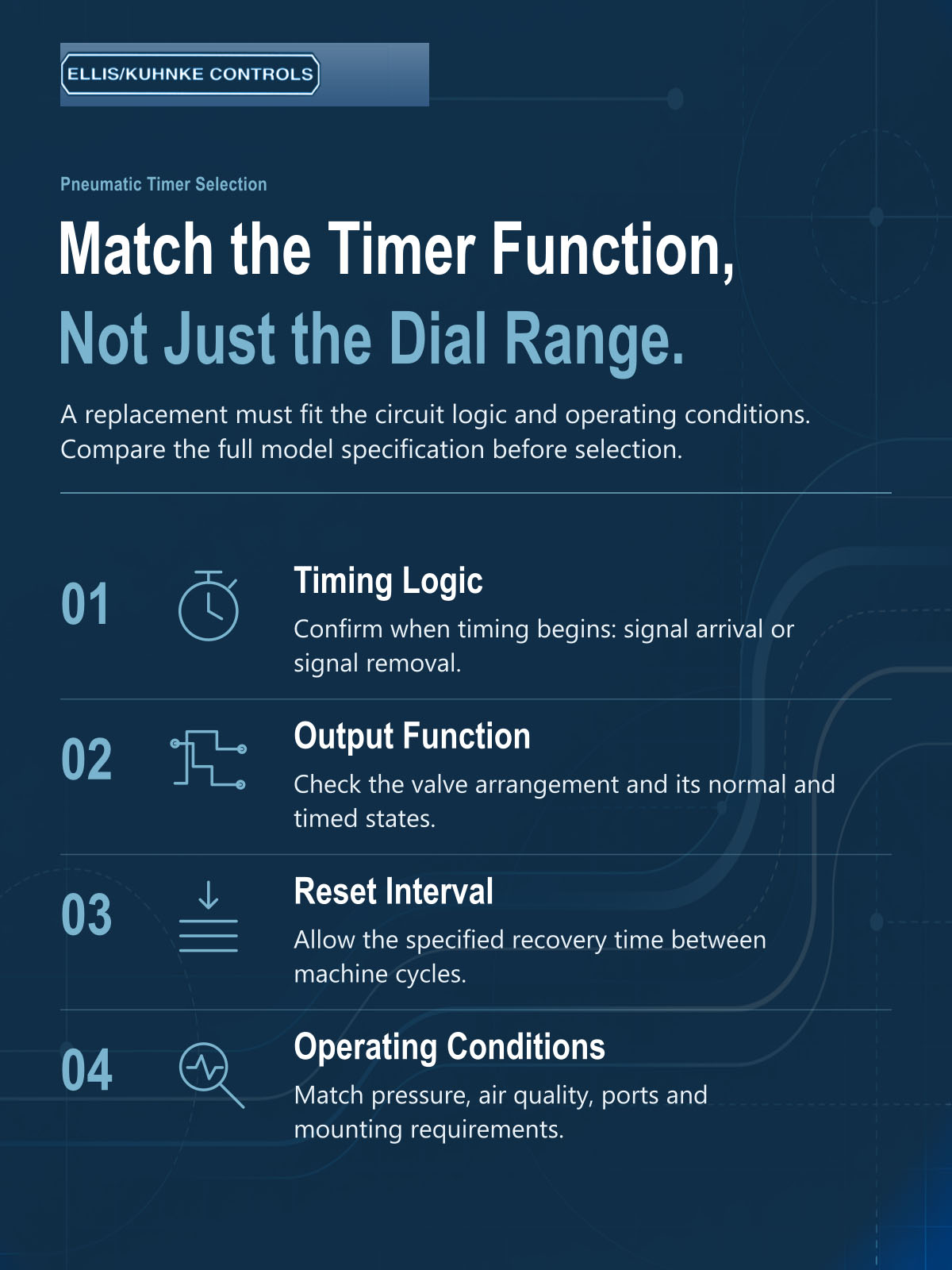
At Ellis/Kuhnke Controls, we want the timing sequence described before a model is chosen. Tell us what starts the delay, what should happen during it, and what the output must do when it ends. That description is more useful than a photograph of the dial alone. It helps avoid a replacement that fits the panel but changes the machine's sequence.
Describe the required delay as an event
Consider a circuit that should wait ten seconds after a maintained control signal arrives before producing its output. That is an on-delay requirement. Now consider a circuit whose output should remain active for ten seconds after the initiating signal disappears. That is an off-delay requirement. Both involve ten seconds, but the event that starts the delay and the required output sequence differ.
These examples explain the distinction; they are not wiring instructions for a particular model. The selected timer's diagram and instructions must establish how its ports and output work. Read “normally open,” “normally closed,” and the timing function in that model's context rather than assume a label gives the whole sequence. Some product families support different functions through different versions or connections.
Write the operating requirement plainly before comparing parts:
- What signal initiates the sequence, and must it remain present?
- What output state is required before and during the delay?
- What should change at the end of the delay?
- What should happen if the initiating signal disappears early?
- What conditions allow the next cycle to start correctly?
That last question is particularly important when the machine repeats quickly. A timer that behaves correctly on a single trial has not necessarily been shown to reset appropriately within the intended cycle.
Do not assume every timer uses the same internal mechanism
Pneumatic timers are not all defined by one universal compressed-air charging process. Our PMT series, for example, uses a timing mechanism involving vacuum and atmospheric pressure and is offered for an on-delay function. Its timing principle differs from the simple pressurized-reservoir explanation often applied to pneumatic timers generally. Use the documentation for the actual series rather than carry a mechanism description from one product to another.
That distinction also prevents an important misunderstanding about specifications. Timing described as independent of line-pressure variation does not mean the whole device works without regard to its supply and control requirements. The timer still has operating limits and connections to follow. A statement about the timing mechanism must not be turned into permission to ignore the rest of the data sheet.
Compare more than the dial and mounting holes
A replacement evaluation should put the old and proposed models side by side. If the original number is obsolete or unreadable, gather the circuit documentation and describe the sequence rather than select the nearest-looking item. Similar appearance does not establish functional interchangeability. Nor does a shared maximum time setting establish that the desired setting falls within both units' usable ranges.
Item to compare | Why the match matters |
Timing function and initiating event | The delay must occur at the right point in the sequence. |
Output function and port arrangement | The downstream circuit must receive the intended state and connection. |
Required time range and timing specifications | The selected unit must support the required interval under stated conditions. |
Reset requirements and cycle pattern | The next operation must begin from the required starting condition. |
Supply, control, mounting, and environmental requirements | Physical fit alone does not establish compatibility. |
Keep reset requirements specific to the model. A universal reset time copied from an unrelated timer is not a safe basis for a substitution. If documentation is incomplete, resolve that uncertainty before installation. Do not assume that the shorter the cycle, the more closely a replacement will behave like the original.
Verify the sequence, not just one timeout
The responsible qualified technician should verify the proposed replacement through the machine manufacturer's approved process. That includes the relevant starting condition, the delay, the output transition, and the return to the next cycle. Repeated operation matters because an isolated timeout does not demonstrate the full sequence. The acceptance requirements should come from the application, not from whether the dial appears close to the requested value.
Servicing also requires the appropriate isolation and control of hazardous energy, including stored air. Do not bypass a guard or interlock to demonstrate that a timer “works.” A pneumatic timer is not automatically a safety-rated control or approved for a hazardous location merely because it does not use an electrical timing circuit. Those applications need their own documented suitability and approvals.
Match the function before ordering the replacement
Pneumatic timers with the same time range may behave differently because the starting event, output, reset conditions, and operating requirements differ. The right replacement reproduces the required sequence within its specifications; it does not merely reproduce the number on the dial.
Send Ellis/Kuhnke Controls the existing part number, a clear label photograph, the pneumatic schematic, and a short description of what must happen before and after the delay. Include the required interval and cycle pattern. We can discuss a suitable timer family and the model details that need to be confirmed before your technician installs a replacement.
Related Reading
- Why Do Stamping Presses Still Rely on Mechanical Pneumatic Counters?
- Why Use Pneumatic Controls Instead of Explosion-Proof Cabinets?
- Pneumatic Timers: What Should You Confirm Before Replacing a Timing Unit?
- Pneumatic Controls: What Should You Check When a Valve, Timer, and Pressure Signal Do Not Agree?
- Understanding Pneumatic Timer Failures in Real-world Applications


- Ellis/Kuhnke Controls
132 Lewis Street Unit A-2, Eatontown, N.J. 07724
Phone: 1-800-221-0714
Fax: 732-291-8154
Email: Info@ekci.com
- Home Pneumatic Controls Technical Info CAD Drawings Contact Us Pneumatic Timers Blog Site Map